Dog Nosework Kit: What You Actually Need to Get Started
Editor's note: This guide is written by a certified fear-free dog trainer and built on Wild Pack's approach: nervous-system-first, instinct-led, and fear-free.
Here's something nobody tells you when you start shopping for a dog nosework kit: the best beginner kit might already be sitting in your recycling bin. Cardboard boxes. A few treats. A dog with a nose.
That's enough to begin.
Eventually, you may find yourself shopping for scent tins, odor jars, and other specialized equipment. But before filling your cart, it helps to understand what all that gear actually does—and when your dog really needs it.
Table of Contents
Key Takeaways
What's Actually Inside a Dog Nosework Kit?
The Best Beginner Kit Might Be Free
What Your Dog Is Really Learning
When Target Odor Kits Become Useful
From Cardboard Boxes to Advanced Nosework
How to Choose a Dog Nosework Kit
The Wild Pack Approach
Frequently Asked Questions (FAQs)
Key Takeaways
Beginners can start nosework with treats and ordinary household objects - no need for specialized equipment.
A dog nosework kit becomes more useful when you're ready to introduce target odors or more structured scent work.
The goal isn't to collect gear. It's to give your dog opportunities to sniff, investigate, make choices, and solve problems.
Watching how your dog searches can teach you just as much as seeing whether they find the hide.
What's Actually Inside a Dog Nosework Kit?
Open a more advanced nosework kit and you may find scented swabs, small round tins, odor vessels, and labeled jars for keeping scent materials organized. Some target odor kits are designed specifically for introducing odors used in structured scent work.
You may also encounter 3D printed nosework vessels that allow odor to escape while keeping the scented material contained. These tools become useful when you're deliberately teaching your dog to search for a particular target odor rather than simply hunting for food.
But none of these things teach your dog how to smell.
That's the funny part. We buy the equipment, read the instructions, and carefully arrange everything—but the dog walks into the room already possessing the most sophisticated piece of equipment involved.
Their nose.
The Best Beginner Dog Nosework Kit Can Be Free
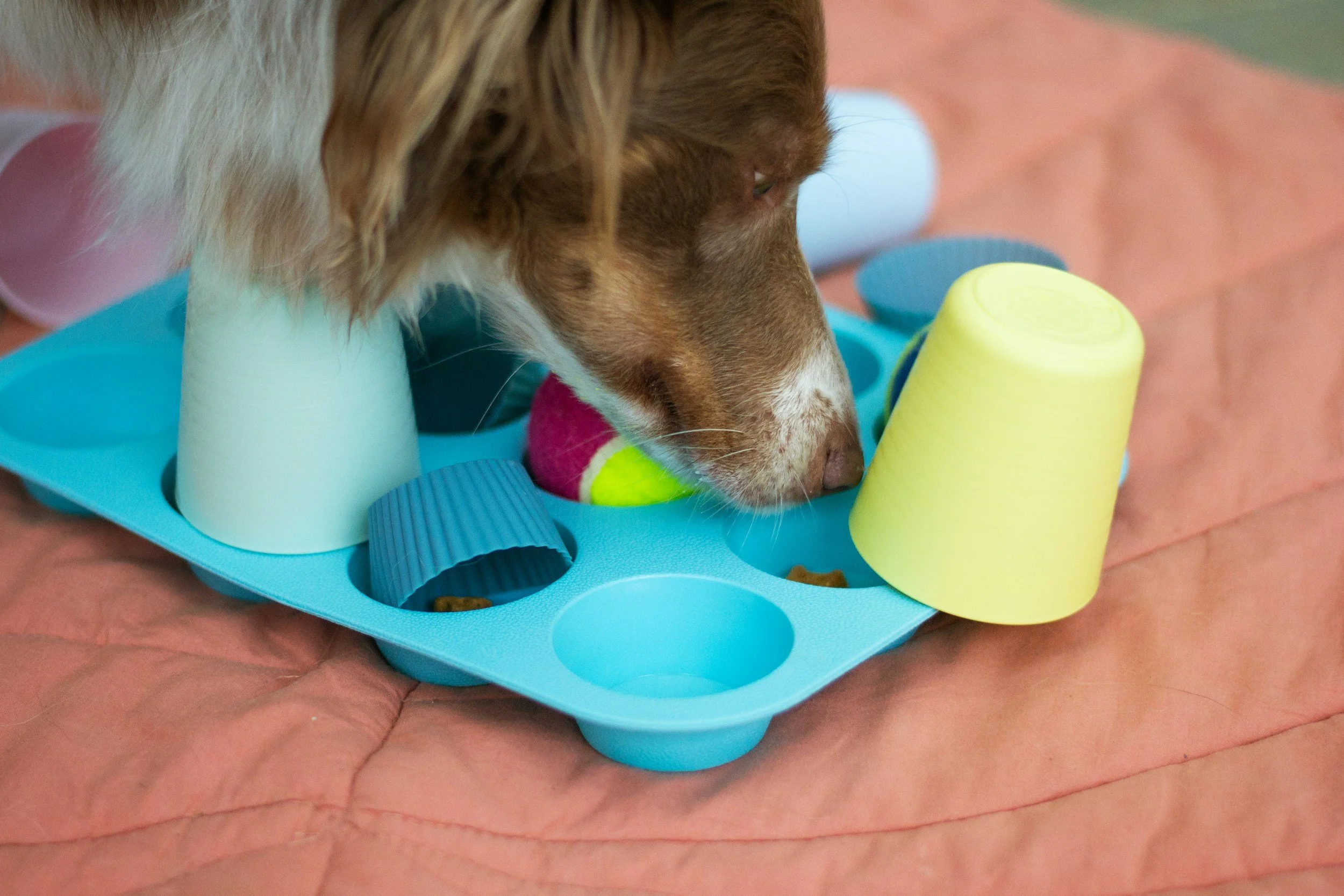
Before ordering anything, find a few cardboard boxes and grab some treats your dog enjoys. Put food in an easy location and give your dog time to discover it.
That's a nosework session in its simplest form.
Once your dog understands the game, add another box. Change the arrangement. Try another room. Gradually, an ordinary collection of household objects becomes a source of mental stimulation because your dog has to gather information and solve the problem.
This can be especially interesting for active dogs whose enrichment tends to revolve around physical exercise. Nosework offers a different challenge: instead of moving faster, your dog gets to slow down and investigate.
And here's where humans usually have the harder lesson: don't immediately help.
What Your Dog Is Really Learning
Watch your dog closely during a search and you may notice something change before they find the reward. They might suddenly slow down, turn back toward something they passed, lower their head, or become intensely interested in one small area.
That's the part of nosework that’s fascinating.
Your dog isn't simply following your directions to get a treat. They're making decisions using information delivered by their sense of smell - information you don't have access to.
That independence can create opportunities for confidence building, provided we don't make the challenge overwhelming. From a fear-free perspective, the goal isn't to keep making searches harder until the dog struggles. It's to find a level where curiosity, persistence, and success can coexist.
For active dogs, that can also introduce a different kind of activity. Not every enriching experience has to involve running farther, playing harder, or adding another physically demanding dog sport.
When Target Odor Kits Become Useful
Food searches are a wonderful introduction, but some people eventually want to explore more structured scent work. That's when a dedicated kit starts making more sense.
Instead of searching for the smell of a treat, the dog can learn that finding a particular target odor leads to reinforcement. At this stage, odor preparation and storage matter more because you want to avoid accidentally spreading scent where you don't intend it to be.
This is why scented swabs, tins, dedicated vessels, and clearly separated storage aren't just fancy training accessories. They help the human control the scent problem more carefully while the dog solves it.
If formal Canine Scent Detection interests you, working with an experienced instructor can also help you learn proper odor handling and recognize your dog's search behavior.
From Cardboard Boxes to Advanced Nosework
There's no reason to rush from treats in a box to advanced nosework. Progress should happen because your dog understands and enjoys the game, not because beginner searches seem too simple to us.
More advanced searches might involve different environments, more complicated hide locations, or specific target odors. For people interested in organized scent work, specialized dog sport gear and other training accessories may eventually become useful.
But nosework doesn't need to become a competition to matter.
This is worth remembering with active dogs, especially when we start comparing activities. Dock Diving, for example, asks something very different of a dog than scent work does. Likewise, equipment sold as Tactical Gear, waterproof collars, or resources labeled Protection Fundamentals may appear alongside other dog-sport products, but that doesn't make them necessary for nosework.
The activity should determine the equipment—not the other way around.
How to Choose a Dog Nosework Kit
Before buying a kit, ask yourself one question: What am I actually planning to teach my dog?
If your goal is dog enrichment at home, you may not need a commercial kit yet. Treats, boxes, towels, and safe household objects can create dozens of searches without adding another product to your dog cupboard.
If you're moving toward target-odor work, look for a kit designed for the type of scent activity you intend to pursue. Check what odors, vessels, storage containers, and instructions are included rather than choosing the kit with the longest equipment list.
And be cautious of products promising that nosework equipment itself will fix behavioral problems. Nosework can provide meaningful enrichment and opportunities for independent problem-solving, but a tin or scent jar isn't a treatment for fear, reactivity, aggression, or separation anxiety.
A good kit makes it easier to create the experience. It isn't the experience itself.
Don't Let the Gear Become the Goal
We humans are very good at turning hobbies into shopping lists. Dogs have a wonderful way of reminding us that things can be simpler.
Your dog doesn't know whether the hide came from an expensive scent kit or yesterday's delivery box. They know there's something worth investigating—and, for once, you're allowing their instincts to guide what happens next.
That's what makes nosework so appealing. You create the opportunity and conditions, but you don't need to solve the problem for your dog.
Sometimes the most valuable part of a dog nosework kit isn't what's inside the box. It's what happens when you stop giving instructions and watch your dog become the expert.
Looking to master beginner nosework? Download our nosework guide.
Read more on what is nosework, mental enrichment games for dogs, and beginner nosework supplies.

Frequently Asked Questions (FAQs)
-
Simple dog training commands such as wait, come, leave it, and place can be useful before or after a search, but nosework itself gives your dog more independence. Once the search begins, resist the urge to direct every move and give your dog room to investigate.
Understand more about dog training in this article.
-
Absolutely. Dog nosework training can begin with treats and cardboard boxes, making it one of the easiest enrichment activities to introduce at home. Specialized equipment becomes more relevant when you progress to target odors or formal scent work.
-
Dog nose work classes aren't required for recreational nosework, but a good instructor can help you learn how to read your dog's search behavior. Classes can also be valuable when you're ready to progress into target-odor work or more structured searches.
-
For recreational nosework, treats and several dog-safe containers may be enough. If you're introducing target odors later, your kit may expand to include swabs, scent vessels, tins, and separate storage containers. Read more about beginner scentwork supplies here.
-
Yes. Cardboard boxes, towels, paper bags, cups, and other safe household objects can become beginner search equipment. Keep early searches easy enough for your dog to understand before gradually adding complexity.
-
Consider specialized equipment when you're ready to work consistently with target odors or prepare for organized scent activities. Until then, your dog can learn an enormous amount with very little equipment—and you can learn an enormous amount simply by watching them search.