How to Teach Your Dog Scent Work in Just 5 Minutes a Day
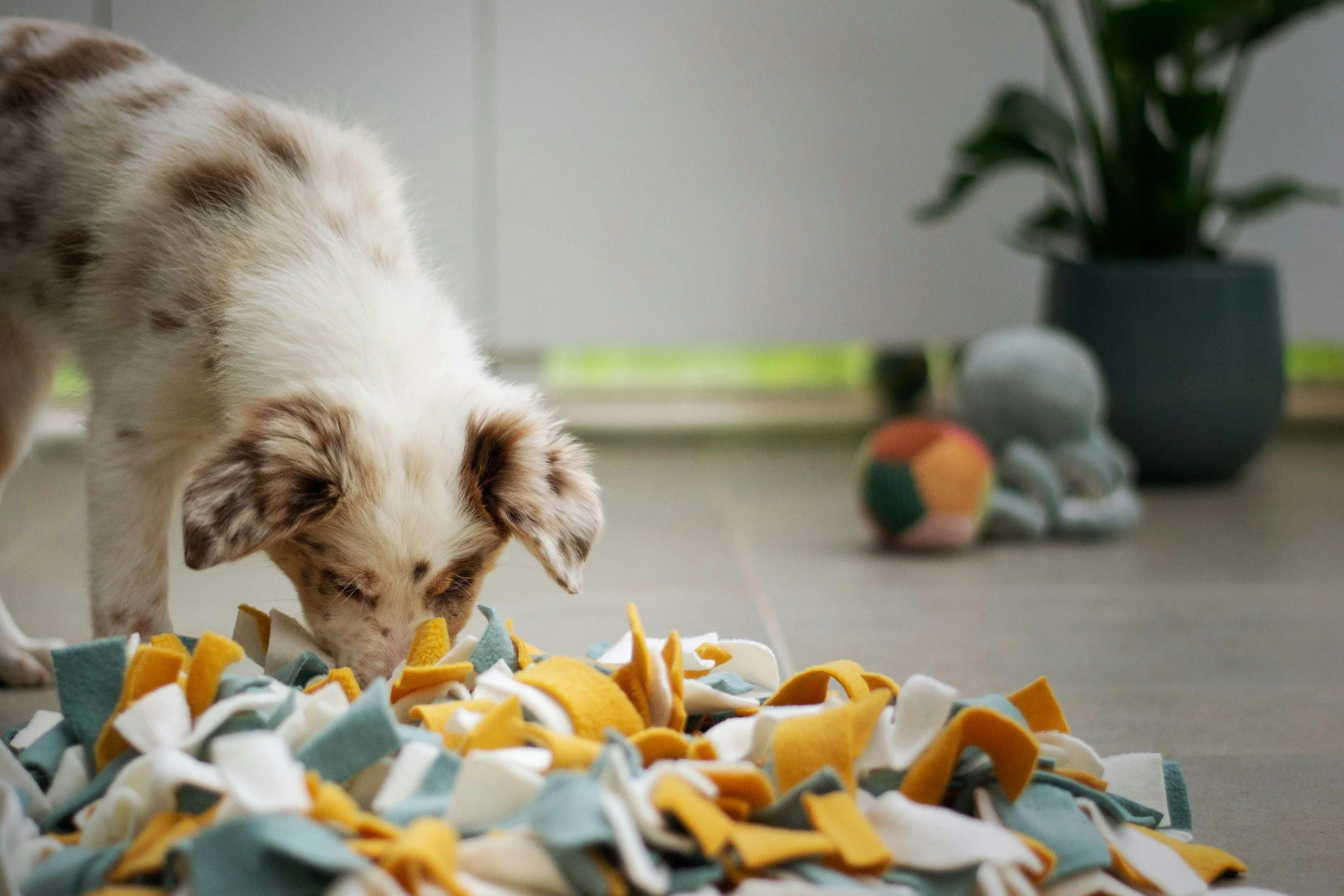
Editor’s Note: This article was written by a Certified Fear Free trainer.
Learning how to teach your dog scent work can sound like another project to add to your schedule.
Buy the equipment. Learn the technique. Set aside training time. Teach the right behaviors. But your first scent work routine can be much smaller than that.
Take five minutes, grab a few treats, and create one easy search. Tomorrow, do it again with one small change. Over time, those tiny sessions can teach your dog what the game is about while teaching you how to make searches that are interesting without becoming frustrating.
Table of Contents
Key Takeaways
What Can You Really Teach in Five Minutes?
Minute One: Set Up an Easy Win
Minutes Two and Three: Let the Nose Take Over
Minute Four: Change Just One Thing
Minute Five: Finish Before It Stops Being Fun
Tomorrow, Don’t Start Over—Build On It
What Equipment Do You Need?
Do You Need Obedience First?
When Five Minutes Turns Into Something More
Make Scentwork Small Enough to Actually Do
Frequently Asked Questions (FAQs)
Key Takeaways
Learning how to teach your dog scent work doesn't require long training sessions.
Start with food and easy searches before worrying about equipment or target odors.
Five minutes gives you enough time for several short searches without turning enrichment into another big task.
Progress by changing one part of the search at a time—not by making every session dramatically harder.
What Can You Really Teach in Five Minutes?
Quite a lot, because you're not trying to accomplish everything at once.
A beginner doesn't need to teach formal scent work, complicated indications, or specific target odors on day one. Your first goal is much simpler: help your dog understand that there is something worth searching for, and that a certain word means the game is on.
Pick a search cue, like "find it," and use the same words every time. Place a treat somewhere easy to find, give your cue, and step back. Let your dog do the work. When they find it, the reward happens right there at the hiding spot.
Reset and try again.
A few successful repetitions are enough for one session. You can always come back tomorrow.
Minute One: Set Up an Easy Win
For your first search, don't be clever. Hold your dog back, or ask a helper to, while they watch you place a treat a few feet away. Then bring them to the same starting spot each time, a doorway or the edge of a rug works well. That spot becomes their signal that a search is about to begin.
Give your cue, release them, and let them find it. Pay them right where the treat was. Then try another easy location.
We're often tempted to test dogs immediately, but early searches aren't supposed to reveal how talented your dog is. They're helping your dog understand the activity.
Think of the first minute as an introduction: When you hear this word, there is something here for you to find.
Minutes Two and Three: Let the Nose Take Over
Once your dog understands the game, stop letting them watch where the treat goes.
Set out three or four cardboard boxes. With your dog held back or out of the room, visit every box and pretend to drop something in each one, but only leave a treat in one. Now your dog can't rely on their eyes. They have to use their nose.
Bring them to their starting spot, give your cue, and step back. Resist the urge to point, hover, or walk them toward the right box. Stay quiet and let them work it out. When they find it, reward right at the box.
Now watch what changes.
Your dog may lower their head, move more slowly, double back, or check several boxes. Their search style may look completely different from another dog's, and that's part of what makes watching them interesting.
If your dog struggles, make the next search easier. You're building a routine, not administering a test.
Minute Four: Change Just One Thing
This is where a simple scent work routine can become surprisingly varied.
Move the boxes to a different room. Or keep the same room and add a couple more boxes. You could move from an indoor search to a safe outdoor area another day.
Just don't change everything at once.
When we alter the location, hiding difficulty, reward, distractions, and search area simultaneously, we make it difficult to tell what challenged the dog. Keep your cue and starting routine the same every time. That consistency is what tells your dog it's the same game, even when the puzzle changes.
Good dog nose work training doesn't need to race toward complexity. One thoughtful change can create an entirely new problem for your dog's nose.
Minute Five: Finish Before It Stops Being Fun
The final minute doesn't need to contain your hardest search. In fact, consider ending with something your dog can solve comfortably. Then stop.
This can be surprisingly difficult for humans. When our dog is succeeding, we naturally want another repetition—and then another.
But enrichment doesn't become more valuable simply because it lasts longer. Five minutes isn't a mandatory limit, either. It's a useful reminder that a short, engaging session can be enough.
Tomorrow, Don't Start Over—Build On It
The next day, you don't need an entirely new lesson. Start with a familiar search from yesterday, then introduce one small difference.
Maybe the loaded box moves to the end of the line instead of the middle. Maybe you tuck a box behind a chair or half under a table. Eventually, your dog might search a whole room with no boxes at all.
This is where dog scentwork games become useful. Different games don't have to be random activities. They can be new versions of a skill your dog is beginning to understand, with the same cue, the same starting spot, and the same payoff at the find.
Over several short sessions, you're building familiarity without turning scent work into a huge commitment.
What Equipment Do You Need?
For beginner searches? Very little.
A few cardboard boxes and some treats your dog loves are all you need. Boxes are the standard starting point in nose work: they're cheap, easy to move, and they quickly become a signal to your dog that it's time to search. Keep treats in a small container or paper cup inside the box so the food doesn't leave residue on the cardboard.
You don't need to purchase a Dog Nosework Kit before discovering whether your dog enjoys searching.
If you later move into structured odor work, dedicated equipment may become useful. But buying more gear doesn't automatically create a better search.
Start with the dog, not the shopping list. Read here for more on beginner nosework suppies.
Do You Need Obedience First?
No long list of simple dog training commands is required before your dog can start searching.
Basic skills can certainly make everyday life and training easier. But scentwork isn't a reward dogs earn after becoming perfectly obedient.
A beginner search can be incredibly simple: create a safe area, hide something your dog wants, and let them investigate.
This also makes scentwork accessible for puppies. If you're exploring how to teach a puppy to be calm, short sniffing activities can be one quieter form of enrichment alongside appropriate play, movement, sleep, and downtime. They shouldn't be treated as a magic switch for puppy energy.
When Five Minutes Turns Into Something More
You may eventually want to move beyond casual food searches.
That's where dog nose work classes can help. A reward-based instructor can introduce more structured searches, teach you how to handle target odors, and help you become better at recognizing what your dog is doing during a search.
Or you may decide that five-minute searches around the house are exactly what you and your dog enjoy.
Both are valid.
Scentwork doesn't have to become a sport, hobby, or serious training project to deserve a place in your dog's life.
Make Scentwork Small Enough to Actually Do
It's easy to save enrichment ideas for the mythical day when we have more time.
But your dog doesn't need an elaborate activity every day.
Hide breakfast in a few boxes. Place treats around a room before your first meeting. Create a tiny search while dinner cooks.
When learning how to teach your dog scent work, consistency can be more practical than complexity. Five minutes gives you permission to start small—and small is often much easier to repeat.
Your dog gets something interesting to investigate.
You get to watch their nose get to work.
And tomorrow, you can do it again.
Read more on training dog to calm with visitors, dog scentwork games, and dog nosework training.

Frequently Asked Questions (FAQs)
-
Begin with food somewhere easy to find. Once your dog understands that searching leads to a reward, gradually introduce new hiding places, objects, or environments.
-
There's no required duration. Five minutes is an approachable starting point, but watch your individual dog's engagement rather than training by the clock.
-
Treat scatters, cardboard-box searches, simple room searches, and finding a favorite toy are easy starting points. Keep early searches achievable while your dog learns the game.
-
No. A dog nosework kit may become useful for structured odor training, but food and safe household objects are enough for beginner searches.
-
You don't need classes for simple recreational searches. Dog nose work classes can be helpful when you want structured instruction, target-odor training, or guidance reading your dog's search behavior.
-
Yes, simple age-appropriate searches can give puppies an opportunity to sniff and investigate. Keep the activity easy, brief, and focused on exploration rather than perfect performance.