What Do Dogs Think About? A Journey Into Their Inner World

Table of Contents
A Different Operating System
Thinking Through A World Of Scent
The Emotional Core Of Your Dog's Thoughts
How Dogs Think To Learn And Solve Problems
How A Dog's Thoughts Evolve Through Life
Key Takeaways
A dog's mind operates on a different wavelength than ours, focusing on the present moment through sensory input, emotions, and instinct rather than abstract language and future planning.
Smell is the primary sense through which dogs "think." Scents create a rich, detailed story of their environment, forming the foundation of their memories and consciousness.
Emotions and thoughts are deeply intertwined for dogs. Feelings like joy, anxiety, and security are not just reactions but are the very core of what they think about.
Dogs are clever problem-solvers who learn through association and observation. Engaging their minds with activities like scentwork taps into their natural instincts and strengthens your bond.
A dog's thought processes evolve throughout their life, from the pure discovery of puppyhood to the experience-based thinking of adulthood and the soulful wisdom of their senior years.
Have you ever watched your dog stare intently into the middle distance, or sniff a single patch of grass for what feels like an eternity, and wondered, what is going on in that beautiful head?
It’s a question that connects all of us who share our lives with dogs. It comes from a place of deep love and a genuine desire to understand the quiet companion who knows us so well.
While they aren’t piecing together sentences or pondering the mysteries of the universe, their inner world is incredibly vibrant and complex. It's a place where a single sniff tells a whole story and a subtle shift in your mood is a conversation in itself.
A Different Operating System
To really get what dogs think about, we have to let go of our human way of seeing things. Our brains are built to process the world through language, logic, and planning for a future that doesn't exist yet. A dog's mind, on the other hand, runs on a different, more ancient wavelength. It's tuned into the rhythms of the natural world and the energy of the present moment.
Their thinking is primarily guided by:
Sensory Input: What are they smelling, seeing, and hearing right now? Their world is a constant flow of information gathered through senses that are far more powerful than our own.
Emotional Feelings: Are they feeling safe, excited, anxious, or content? Emotions are the color palette for every thought and action they have.
Instinctual Needs: Those core drives for survival, connection, and play are always simmering just beneath the surface, shaping their choices from moment to moment.
Think of it this way: we humans tend to live a few steps ahead, constantly narrating and analyzing our lives. Dogs live right in the heart of the experience itself. This guide will walk you through their fascinating inner world, helping you connect with your dog's wild, intuitive self. When we understand how they perceive reality, we can move beyond just training them and begin to truly communicate, nurturing the sacred bond that we are so lucky to share.
Thinking Through A World Of Scent
To even begin to understand what dogs think about, we have to pull ourselves out of our sight-first world and drop right into theirs. For a dog, thinking isn't a neat stream of words or a slideshow of images like it is for us. It's something far more immediate and visceral: a constant, vibrant flow of information gathered primarily through their most powerful sense—smell.
A dog’s nose is their lens for interpreting reality. Where we see an empty park, they perceive a rich, detailed history written in scent. They can tell who was there, their emotional state, where they went, and even how long ago they left. Think of it as their version of reading the morning paper, scrolling through social media, and checking the weather report, all in a single, deep inhale.
Their thoughts are literally built from these scent particles. A specific odor doesn't just trigger a memory; for a dog, that scent is the memory. The faint trace of a familiar dog on the breeze isn't just a clue—it's the thought of that friend, present and immediate in their mind. This sensory landscape is the very foundation of their consciousness.
The Nose Knows Everything
Imagine walking into a room and instantly knowing the emotional history of everyone who has been there in the last day. That’s a small glimpse into your dog’s everyday reality. Their sense of smell is estimated to be between 10,000 to 100,000 times more sensitive than ours, all thanks to having up to 300 million olfactory receptors compared to our meager six million.
This superpower means their thoughts are intricately connected to scent data. They aren't just thinking "food"—they're thinking in the complex aromatic notes of roasted chicken versus raw beef. This is why tapping into their natural scenting abilities is one of the most profound ways we can connect with their inner world.
A World In Motion And Sound
While scent is definitely the star of the show, their other senses play crucial supporting roles in building their worldview.
A dog’s vision is uniquely tuned to its ancestral purpose. They see fewer colors than we do, perceiving the world mostly in shades of blue and yellow. But their eyes are absolute masters at detecting motion, able to spot the slightest rustle of a squirrel in the bushes from a great distance. This motion-first vision means their thoughts are often triggered by movement—a powerful, instinctual holdover from their days as wild hunters.
Hearing also plays a vital part. Dogs can hear frequencies far higher than humans, picking up on sounds we are completely oblivious to. The high-pitched whine of electronics or the distant jingle of a collar are all part of their cognitive landscape, painting a detailed auditory picture of their environment. Their thoughts are often a direct reaction to these sounds, which signal everything from your arrival home to the presence of a stranger.
When you see your dog pause on a walk, it's a moment of deep thought. They are processing a symphony of sensory data:
The lingering scent of a rabbit that passed by an hour ago.
The subtle movement of leaves rustling in the wind.
The distant sound of another dog barking two streets over.
Each piece of information combines to create a rich, immediate thought that is deeply rooted in the present moment. By engaging these natural abilities, you are truly speaking their language.
If you’re curious about awakening this powerful instinct, our dog scentwork training guide for beginners is the perfect place to start. It offers simple, soulful ways to turn playtime into a powerful bonding ritual.
Ultimately, by understanding how this sensory tapestry weaves together, we can better appreciate what our dogs think about. Their minds are not empty, but full of a rich, wild, and beautiful perception of a world we can only begin to imagine.
The Emotional Core Of Your Dog's Thoughts
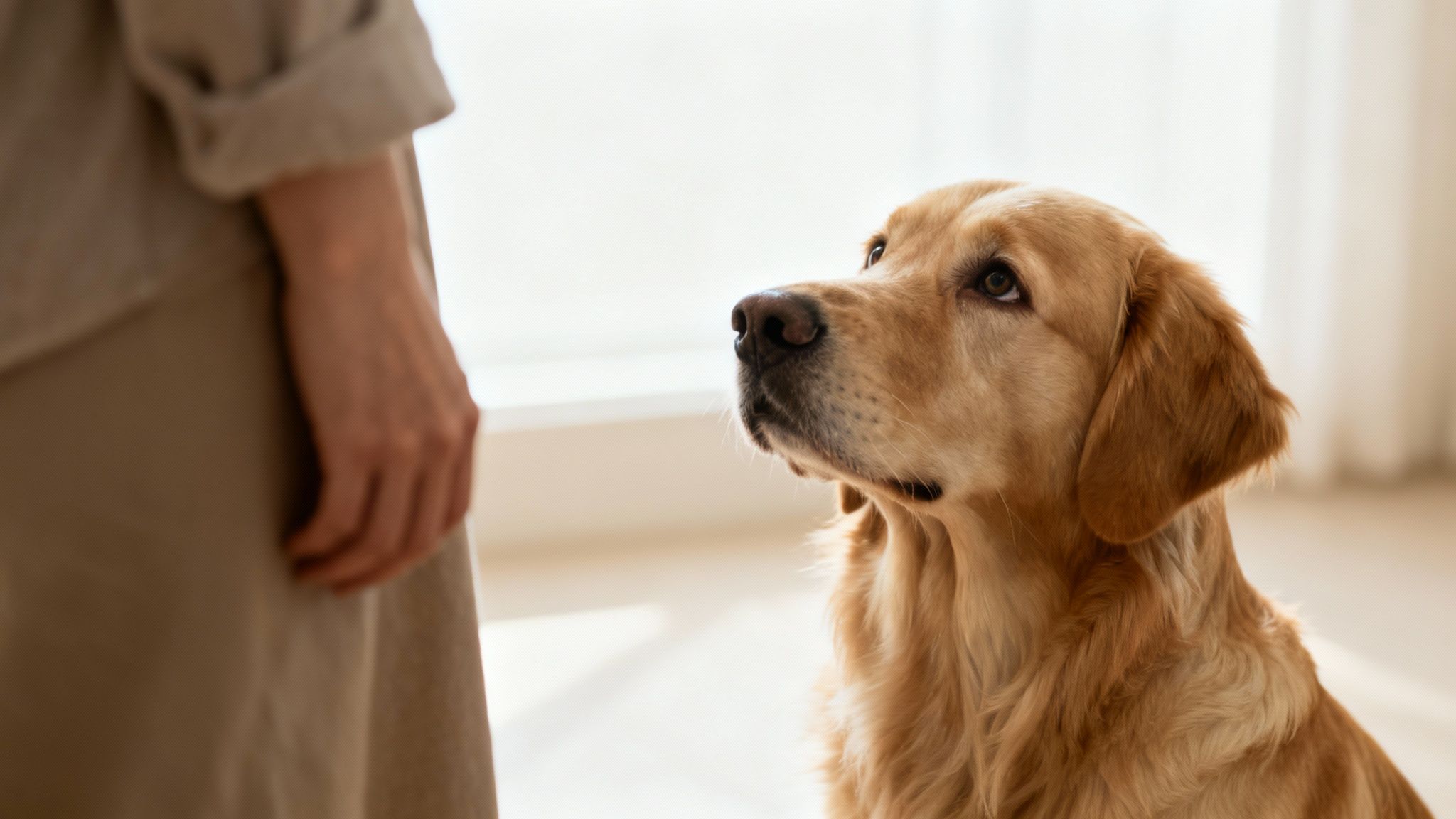
If the world of scent and senses is the landscape of your dog's mind, then their emotions are the weather. They’re the deep, powerful currents that sweep through their consciousness, coloring every single thought and shaping every action.
It’s easy for us to spot the obvious feelings—the pure, uninhibited joy of a full-body tail wag or the sad whimper when you head out the door. But their emotional world is so much richer and more nuanced than we often give them credit for.
A dog’s thoughts aren't separate from their feelings; they are completely intertwined. The quiet worry they feel when they see you packing a suitcase is what they are thinking about. That rush of excitement at the sight of a leash is a thought made of pure, happy anticipation.
Understanding this emotional core is everything. It moves us beyond just managing behavior and into a space of true, intuitive connection—the kind of sacred bond that is the very heart of the Wild Pack philosophy.
More Than Just Happy Or Sad
For a long time, the depth of canine emotion was brushed aside. We know better now. A growing body of scientific evidence reveals that dogs experience a spectrum of feelings that are strikingly similar to our own primary emotions. These aren't just simple reactions; they are complex emotional states that guide their inner world.
MRI scans have shown that the same brain regions that light up in humans when we experience emotions like fear or connection are also active in dogs. This shared neurochemistry means that what a dog thinks about is often rooted in a feeling we can understand on a deeply human level. It’s a bridge between our species, a common language of the heart.
This shared emotional wiring allows for a surprisingly wide range of feelings:
Anxiety: The pacing and panting when a thunderstorm rolls in isn't just a behavior. It's a thought pattern completely consumed by a feeling of unease.
Jealousy: When another dog gets a better treat, that feeling of being slighted is a very real thought, driving them to nudge your hand for their fair share.
Optimism: That hopeful gaze and alert posture they adopt when you're in the kitchen is a mind filled with the positive expectation of a dropped crumb.
When we recognize these deeper feelings, we can respond with far more empathy. We start to see their actions not as "bad behavior" but as expressions of an inner emotional state that needs our support. You can explore more about how these feelings manifest by reading our guide on if dogs get jealous.
A Mind Shaped By Feeling
A dog’s emotional state is the filter through which they process every piece of information from the world.
Think about it this way: a confident, secure dog might see a new person as an exciting opportunity for play. An anxious dog, however, might see that exact same person as a potential threat, processing their presence through a lens of fear. Their thoughts are a direct reflection of their inner emotional climate.
This is why creating a sense of safety and trust is the absolute foundation of a healthy relationship. The loving rituals we create and the consistent care we provide don't just make a dog "happy." They fundamentally shape their cognitive patterns, helping them think about the world from a place of calm and confidence.
How Dogs Think To Learn And Solve Problems
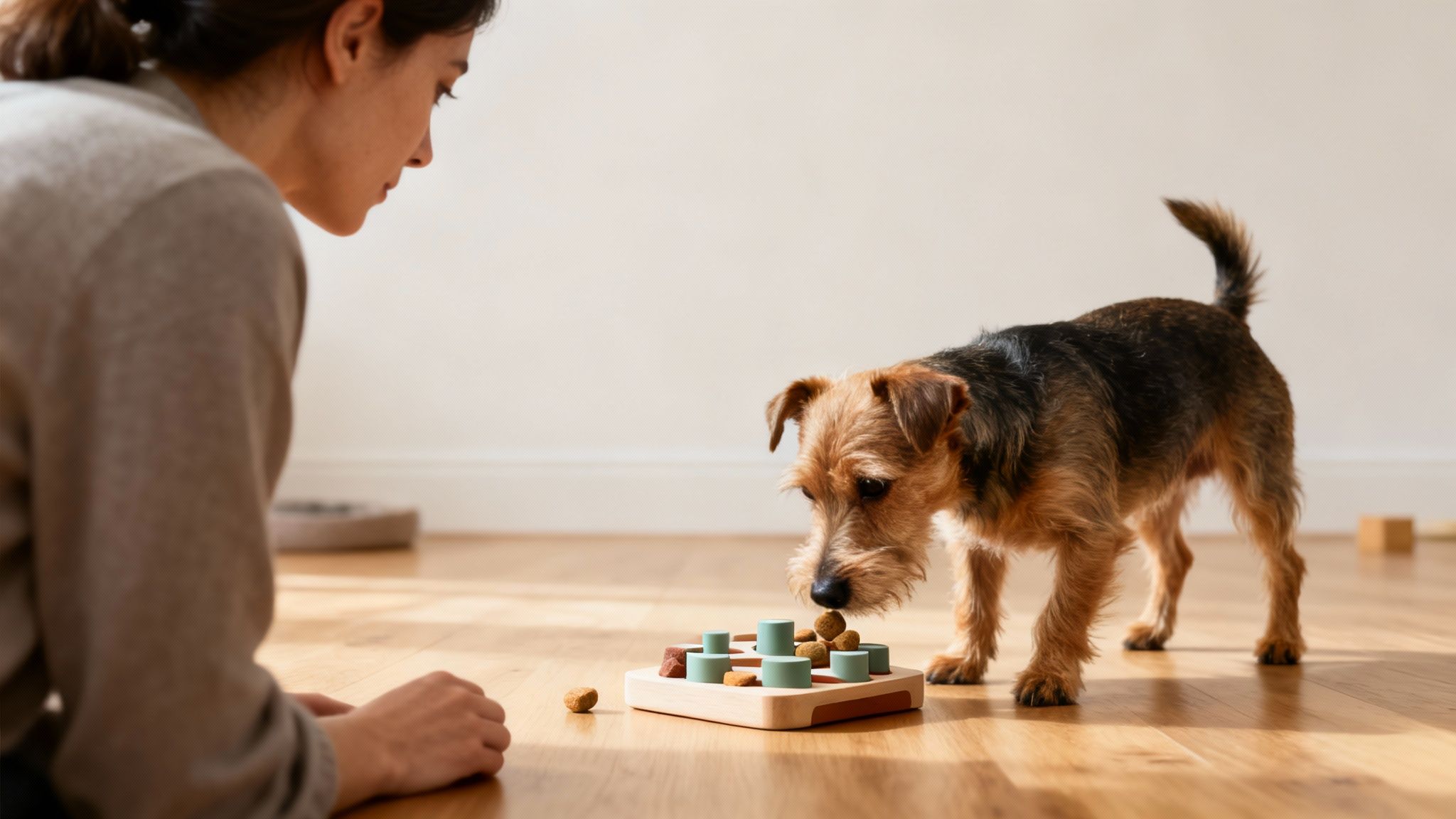
Your dog's mind isn't just passively taking in the world—it's an active, clever problem-solver. A huge part of what dogs think about is simply navigating their environment, making connections, and figuring stuff out. This isn’t about high-level abstract reasoning, but a beautiful and practical intelligence driven by instinct.
At their core, dogs are masters of association. When your dog connects the jingle of your keys with an impending walk, they're thinking predictively. This is the very foundation of how they learn: linking one thing to another. Your words, gestures, and even your energy become signals they interpret to understand what’s coming next.
This is where training becomes less about obedience and more of a deep, instinctual conversation. We're not just barking commands; we're tapping into their innate desire to cooperate as a pack. We're speaking a language of action and consequence that their wild heart already understands.
Thinking by Watching and Doing
Dogs are incredible observers. They learn so much just by watching others, whether it's you or another dog. This social learning is a powerful tool in their cognitive toolkit, allowing them to pick up new tricks without the tediousness of trial and error.
Have you ever seen your dog figure out how to nudge a cabinet open after watching you do it? Or a young pup learning social etiquette from an older dog at the park? That’s their problem-solving mind in high gear. They watch, process, and then apply what they saw to their own situation.
Recent research out of Finland has shed even more light on these amazing abilities. A study of nearly one thousand dogs found direct links between their performance on cognitive tests and their daily behaviors. For instance, dogs who showed better self-control in a puzzle were also less impulsive in their everyday lives. You can read more about the University of Helsinki's fascinating findings on canine cognition.
This research really drives home that problem-solving isn't just about getting a treat. It's about self-control, spatial awareness, and logical reasoning—all skills that help them live more harmoniously in our shared world.
Awakening Their Inner Problem-Solver
Every single dog has a natural drive to explore, forage, and use their brain. But in our modern lives, it’s easy for these instincts to go dormant. When we give them opportunities to think and solve problems, we reawaken a vital part of their wild self.
This is so much more than just keeping them busy; it’s a form of mental and spiritual nourishment. Activities that engage their mind build confidence, ease anxiety, and deepen the bond you share.
Puzzle toys are a fantastic way to start, encouraging strategic thinking to get to a reward.
Teaching new tricks sharpens their associative learning and strengthens your communication.
Nosework is one of the most powerful ways to honor their natural gifts, turning their incredible sense of smell into a fun and fulfilling game.
Ready to turn playtime into a powerful rewilding ritual? Awaken your dog’s natural drive and brilliant mind by downloading our free nosework guide.
👉 https://www.withwildpack.com/dognoseworkguide
Engaging their mind is a cornerstone of our rewilding philosophy. It's about seeing your dog not just as a pet, but as an intelligent being with a rich inner life that's just waiting to be explored. You can find many more creative ideas in our guide to dog mental stimulation games.
If a dog’s world is built on smells and feelings, then memory is the invisible thread that weaves it all together. But a dog's memory doesn't work like a film reel, replaying last Tuesday's walk in chronological order. Instead, their minds are a brilliant, lightning-fast web of associations.
This is the absolute key to getting inside their heads. For a dog, one thing powerfully predicts another. That specific crinkle of the treat bag, the jingle of your keys, the sound of your car turning onto your street—these aren't just isolated noises. They are triggers, instantly pulling a whole cascade of feelings and expectations into the present moment.
Their thinking is rooted in these powerful connections. The sight of a leash doesn't make them think, "Oh, I remember we went for a walk yesterday and it was fun." The leash becomes the walk. It is an immediate, full-body feeling of excitement for what’s about to happen right now.
A Tapestry Of Associations
You could say a dog's memory is less like a library of stories and more like a living, breathing map of cause and effect. This is what's known as associative memory, and it's incredibly potent in our canine companions. Every single experience, good or bad, spins a new thread into this mental tapestry.
A certain scent can instantly bring back the feeling of comfort they have with their favorite person. A loud, unexpected bang can trigger the visceral memory of fear from a past trauma. These memories aren't abstract thoughts; they are felt, in-the-body experiences that guide how they think and react in the here and now.
This is exactly why our daily rituals carry so much weight. A calm morning routine, a predictable feeding time, a consistent cuddle on the couch—these become powerful, joyful anchors in your dog’s mind. They aren't just habits; they are weaving a story of safety and trust, not in words, but in pure feeling.
Creating Positive Memory Anchors
When you truly grasp the power of associative memory, the Wild Pack philosophy of creating intentional rituals with our dogs just clicks into place. Every single interaction is a chance to build a positive memory, an anchor that will shape their future thoughts.
And when we do things that tap into their primal nature, we’re creating the most profound memories of all. Take scentwork, for example. It doesn't just give their nose a workout; it builds a deep-seated memory of successful problem-solving, of teamwork with you, and of the incredible satisfaction that comes from using their natural gifts.
These shared moments do more than just pass the time—they fortify your energetic bond and build a deep well of security. They become the bedrock of your dog’s inner world, helping them see their environment, and you, as a constant source of safety, connection, and joy.
Just like us, a dog's inner world is in a constant, beautiful state of evolution. Their thoughts aren't static; they're shaped and reshaped by every single stage of their life's journey. What a dog thinks about is a story told in chapters, from the boundless curiosity of youth to the deep, quiet wisdom of old age.
Understanding this progression allows us to connect with them on a much deeper level, honoring their needs at every turn. It’s a core part of nurturing their wild spirit as it grows and changes with time.
How A Dog's Thoughts Evolve Through Life
The Puppy: A Mind of Pure Discovery
A puppy's mind is a whirlwind of newness. Their thoughts are a rapid-fire series of questions driven by pure instinct: What is this? Can I chew it? Is that a friend? Their world is one giant sensory playground, and their primary job is to explore it all—with their mouths, paws, and especially their noses.
During this critical period, their thoughts are also intensely focused on social connection. They are hardwired to learn the rules of their new pack—your family. Their minds are like sponges, soaking up every bit of information about social cues, communication, and where they fit into the rhythm of the home. This early learning forms the very foundation of their future thinking.
This cognitive development starts remarkably early. In fact, studies show that puppies as young as eight weeks old already have measurable cognitive traits, especially in how they think about and connect with humans. Research has demonstrated that a puppy’s ability to follow a person's gaze and their capacity for self-control develop significantly as they mature, showing their minds are actively trying to understand our world from the very beginning. You can learn more about the amazing findings on early canine cognition.
The Adult Dog: A World Shaped by Experience
As a dog moves into adulthood, their thoughts become more refined and grounded in experience. The chaotic discovery of puppyhood gives way to a mind shaped by routine, memory, and the powerful bond they share with you. Their thoughts are now a rich tapestry woven from established patterns and associations.
An adult dog thinks about the predictable rhythms of their day—the morning walk, the afternoon nap in a sunbeam, the sound of your key in the door. These routines aren't just habits; they are mental anchors that create a sense of security and order in their world. Their thoughts are also deeply intertwined with their history. A positive association with car rides leads to thoughts of happy adventure, while a past scare might trigger thoughts of anxiety.
This is the stage where our shared rituals become the cornerstones of their mental well-being. Consistent, mindful engagement helps them see their world from a place of confidence and trust, reinforcing the energetic bond you've built together.
The Senior Dog: A Soulful Deepening
The senior dog's mind is a place of profound depth and soulfulness. While their cognitive processes might slow down a bit, their inner world often becomes richer in other ways. Their thoughts may turn more inward, focused on comfort, safety, and the quiet, grounding presence of their trusted human.
Physical changes can alter their sensory input, but their emotional intelligence and reliance on their bond with you often deepen profoundly. They think about your presence in a way that is essential and centering. Your touch, your scent, and the familiar sound of your voice become the central pillars of their reality. Honoring this stage is about providing gentle enrichment, quiet comfort, and an unwavering sense of connection, cherishing the deep, soulful wisdom they now embody.
Read more about your dog's inner world...
Frequently Asked Questions
Do dogs think in words or pictures?
The best way to imagine it is that dogs think in a rich blend of sensory information—a collage of scents, sounds, and images, all tied together with strong emotional feelings. It’s less of an internal monologue like we have and more of a vibrant, in-the-moment sensory painting where smell is the primary color.
Do dogs think about the future?
Dogs are masters of the present moment. They can anticipate future events through powerful association but don't ponder the future abstractly. When you grab a leash, their thought is the immediate, exciting feeling of a walk, not a memory of yesterday's walk. Their concept of the future is a felt sense, triggered by a cue.
Do dogs think about their owners when they're gone?
Yes, but in their own way. They don't likely "picture" you at work, but your scent on a blanket or the sound of your car returning triggers strong associative memories and feelings of connection and anticipation. Their bond with you is a constant, felt presence in their minds.
Can I influence what my dog thinks about?
You absolutely can. This is the very foundation of the deep connection we build with them. By providing enriching activities that tap into their natural instincts—like scent work or puzzle toys—you guide their thoughts toward a calm, confident, and engaged state, nurturing their wild spirit.
How can I better understand my dog's thoughts?
The most profound way is to become a quiet, patient observer of their body language and energy. Their thoughts aren't spoken in words; they're expressed in the subtle flick of an ear, a slight shift in posture, or the focused intensity of a sniff. Learning to read these signals is like learning their native language.
