Are Siberian Huskies Good With Cats? A Guide to Harmony
Table of Contents
The Wild Instinct Behind the Question
Understanding Your Husky's Prey Drive and Energy
Key Factors for a Peaceful Home
Your Guide to Safe and Mindful Introductions
Creating a Sanctuary for Both Species
Knowing When It's Not the Right Fit
Frequently Asked Questions
Key Takeaways
Siberian Huskies have a strong, innate prey drive due to their history as working sled dogs. This instinct can be triggered by a cat's quick movements.
Success in fostering a harmonious relationship between a husky and a cat relies on early socialization, the individual temperaments of both animals, and consistent, patient management by the owner.
Redirecting a Husky's energy through instinct-based activities like nosework is crucial for a calm household.
Creating a safe environment with vertical spaces for the cat and separate safe zones for both pets is non-negotiable.
Not all Huskies can safely live with cats. Recognizing signs of incompatibility is a responsible part of pet ownership.
So, you're wondering if a Siberian Husky and a cat can share the same home. Here's the honest, straight-from-experience answer: it's complicated, but it's not impossible. Success hinges entirely on one thing: understanding the wild, instinctual heart of your Husky and then mindfully, patiently managing that relationship.
The Wild Instinct Behind the Question
Bringing a Husky into a home with a cat isn't just about hoping they'll become best buddies. Think of yourself as a translator between two completely different worlds. You're asking a creature literally bred for endurance and pursuit to live peacefully alongside an animal that could trigger its deepest, most primal instincts.
Let's look back at their history. Siberian Huskies were the trusted companions of the Chukchi people, bred to thrive in the harsh, unforgiving Arctic. This history isn't just a fun fact; it's etched into their DNA, embedding a powerful prey drive that was essential for survival.
Because of this, the quick, darting movements of a small animal—like a cat skittering across the floor—can awaken that ancient call of the wild. Some statistics even suggest that only about 30-40% of Huskies can be considered reliably safe with cats, especially if they weren't raised together from puppyhood. You can dig deeper into their unique history here.
To be clear, this isn't about blaming the breed. A Husky's prey drive isn't a character flaw to be trained out of them; it's a core piece of who they are. Honoring this truth is the very first step toward creating a safe and peaceful home for everyone. The journey requires you to acknowledge these traits head-on and learn how to manage them with care.
Ultimately, this approach isn't about forcing an unnatural friendship. It's about mindfully integrating two species by respecting what makes them unique.
This means you'll need to focus on:
Creating a safe, enriching space where both animals feel secure.
Redirecting your Husky's boundless energy and drive into positive activities.
Patiently guiding every single interaction from a place of calm, confident leadership.
When you see the situation through this lens, you stop being a referee and become a guardian. You're not trying to tame the wild spirit in your Husky. Instead, you're helping it find a peaceful rhythm within the walls of your shared home.
This perspective is absolutely key to navigating the beautiful complexities of this incredible breed. The goal isn't a fairytale friendship, but a respectful coexistence—a quiet understanding that allows both your cat and your Husky to truly feel safe.
Understanding Your Husky's Prey Drive and Energy
To really get a feel for whether a Siberian Husky can live peacefully with a cat, you have to step inside their world for a moment. Picture a vast, windy, snow-covered landscape where every single instinct is honed for survival. That’s the world that forged the Husky. Their prey drive isn't a flaw or a sign of a "bad dog"; it's a powerful, ancient program hardwired into their DNA.
When your cat suddenly bolts across the living room, that quick, darting movement can flip a switch deep inside your Husky's brain. It’s not a conscious thought. It’s a primal echo that screams one thing: chase. Acknowledging this isn't about making excuses—it's about respecting the beautiful, wild spirit that still lives inside your dog.
The Connection Between Energy and Instinct
That powerful instinct is directly plugged into their legendary, almost bottomless well of energy. Huskies were built to run, and run for miles. If that incredible energy doesn't have a positive, constructive outlet, they will find one for themselves. A bored Husky is a master of chaos, and a cat can easily become the unintended target of all that pent-up drive.
Think of their energy like a powerful river. You can't just dam it up; you have to give it somewhere to go. If left unchanneled, that river will carve its own path, and you might not like where it leads. But when you provide structured outlets, you can guide that force toward something productive and deeply satisfying for your dog.
So, managing your Husky's energy isn't just about preventing a chewed-up sofa. It’s a fundamental part of creating a safe and calm environment for any cats in the home. When a Husky is tired from a good "job" and mentally fulfilled, their prey drive is much less likely to be on a hair-trigger.
Providing this fulfillment is a daily, non-negotiable commitment. We're talking about more than a quick walk around the block. You have to build routines that truly tap into their working-dog heritage. Getting a handle on how often dogs should be walked is a great place to start, but for a Husky, it's just the beginning.
Enrichment activities are your secret weapon here. They channel that instinctual drive away from your cat and toward an appropriate task.
Scent Work: This is a fantastic way to satisfy their innate desire to hunt. Hiding treats and encouraging them to use that incredible nose is a direct line to their seeking instinct. Download our free scentwork guide here.
Puzzle Toys: These challenge their brilliant minds, heading off the kind of boredom that spells trouble.
Structured Play: Games like fetch or using a flirt pole give them a safe, controlled way to chase, pounce, and burn off steam.
By looking at the world from your Husky's point of view, you can learn to appreciate this wild energy instead of fighting it. Rather than trying to suppress it, you can learn to manage and redirect it. This mindful, proactive approach is the bedrock of building a home where both a natural predator and a natural prey animal can coexist in a calm, respectful balance.
Key Factors for a Peaceful Home
While a Husky’s primal instincts are a powerful force, they aren't the whole story. A few key factors can dramatically shift the odds, determining whether your home becomes a peaceful sanctuary or a place of constant stress. Thinking about these ingredients beforehand helps you stack the deck in favor of a calm, respectful coexistence.
The goal isn't to erase your Husky's nature—that's impossible. Instead, it's about creating a situation where their deep-seated pack instincts can override their prey drive. Just like us, a dog's past experiences and earliest relationships play a huge part in how they see the world.
The Power of Early Socialization
Honestly, the single most influential factor is early and positive socialization. A Husky puppy raised alongside cats from a young age is far more likely to see them as part of the family, not something to chase. Their brains are like little sponges during this critical developmental window, from about 3 to 16 weeks of age.
During this period, they're learning what's safe, what's normal, and who belongs to their family unit. A kitten that smells like home and has always been part of the picture is simply another member of the den. This early bonding can literally wire the cat into your Husky’s foundational understanding of their social world.
Individual Temperament Matters
Breed traits give us a general blueprint, but every single animal is an individual. You might find a Husky with a more mellow, less intense drive, while another is a high-octane hunter that makes living with a cat far too risky. The same goes for your cat. A confident, dog-savvy feline who stands its ground is much less likely to trigger that chase instinct than a timid cat who bolts at the drop of a hat.
Think about the unique energy each animal brings to the table:
Your Husky's Personality: Is your pup generally calm and observant, or do they fixate intensely on squirrels, birds, or other moving objects? A high level of intense focus can be a major red flag.
Your Cat's Demeanor: Is your cat bold and unflappable, or anxious and easily startled? A calm cat helps set a much calmer tone for every interaction.
Past Experiences and Histories
Finally, an animal's personal history plays a massive role. If you're looking to adopt an adult Husky, you need to be a bit of a detective and learn as much as you can about their past. A dog with a known history of chasing or harming small animals is simply not a suitable candidate for a home with cats, no matter how much training you plan to do. It’s not worth the risk.
On the flip side, a Husky that has successfully and peacefully lived with cats before has a much higher chance of adapting again. Their past experiences have already taught them that cats can be companions, not prey. Honoring their history is a crucial part of making a responsible and compassionate match. By thoughtfully looking at these three things—socialization, temperament, and history—you can make a much more informed decision for every single member of your pack.
Your Guide to Safe and Mindful Introductions
Bringing a Husky home to a resident cat is less of a single event and more of a delicate, slow-motion dance. You have to honor the instincts of both animals, and that means patience is your best friend. If you rush this process, you're setting the stage for fear and mistrust. The real goal here is to build a foundation of calm neutrality long before they're ever hanging out in the same room.
The first step is all about scent—it's the most primal way animals get to know each other. Before they even lay eyes on one another, start swapping their smells. Take a blanket or a soft cloth, gently rub it on your cat, and place it in your Husky's bed or crate. Then, do the reverse with a separate cloth for your Husky, putting it somewhere near your cat's favorite spot, maybe near their food bowl.
This isn't just busy work; it's a crucial first step. It lets them gather information and get used to each other's presence without any of the stress of a face-to-face meeting. Think of it as letting them read each other’s biography before the first handshake.
The First Visual Meeting
Once they're both totally bored with the scented items, you can graduate to the first visual introduction. This has to happen through a secure barrier—a baby gate is perfect for this, but a slightly cracked door can also work. Keep these initial sessions incredibly short. A minute or two is more than enough to start.
Your job is to create a positive association. During these brief sightings, shower them both with high-value treats. You want them to start connecting the sight of the other animal with something fantastic. If either one shows signs of stress—hissing, growling, or that intense, unblinking stare—calmly end the session. No big deal. Just try again later for an even shorter amount of time.
Patience is everything. Seriously, this is a marathon, not a sprint. One study found that the average time for a Husky to become comfortable with a cat was 4.2 months, and some situations took a year or more of careful management. You can get more details about timelines here.
This diagram really breaks down the core ideas that shape how these introductions will go.
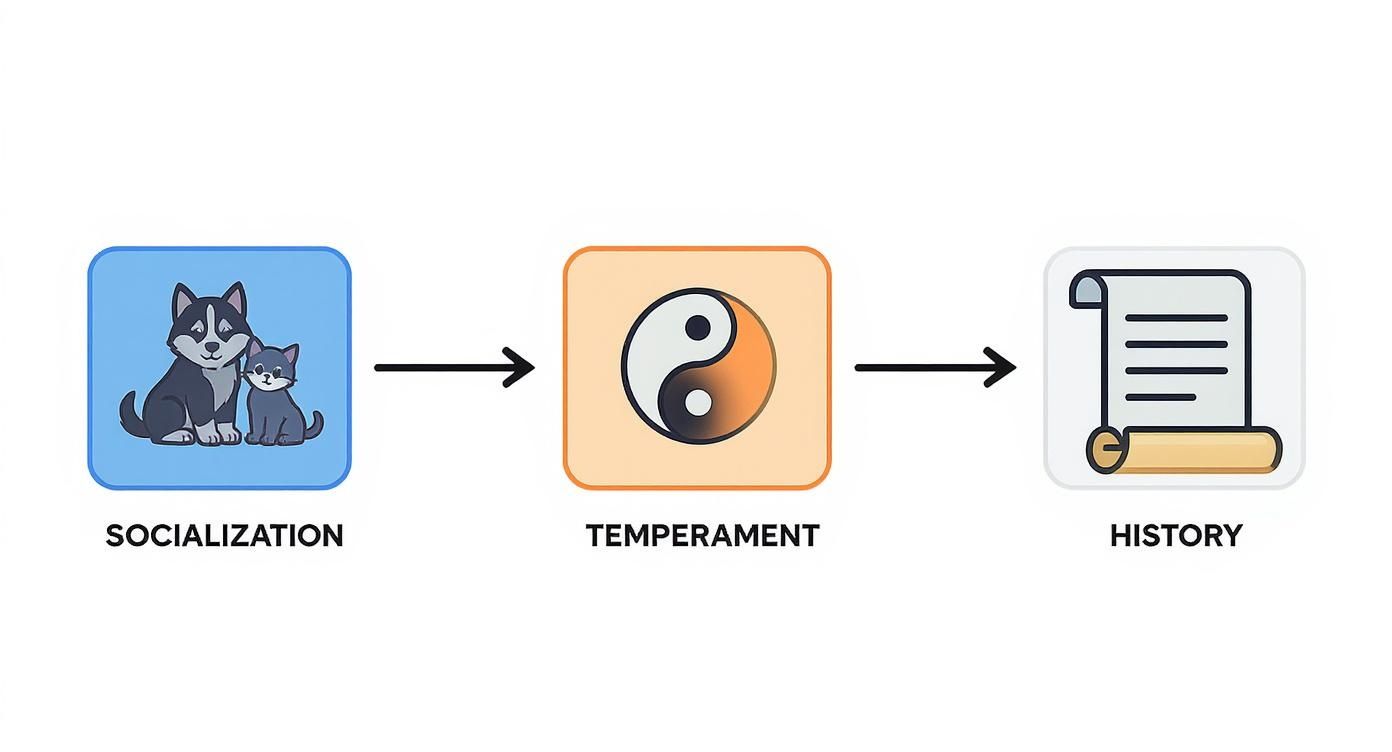
As you can see, a successful, peaceful home really depends on those three pillars: early socialization, the individual animal's temperament, and their past experiences.
Reading Their Language
As you move forward, you become a translator, constantly observing their subtle body language. This silent conversation tells you everything you need to know about whether to push forward or take a step back. True socialization is all about building trust, a concept we explore more deeply in our guide on how to socialize your dog with other dogs.
Here are the green lights you're looking for:
A relaxed, loose body posture in both your cat and dog.
Your Husky glances at the cat and then looks away, showing they aren't fixated.
Your cat does a slow blink or looks away—a huge sign of trust in the feline world.
Both animals are comfortable enough to eat or take treats while in sight of each other.
On the flip side, be ready to call it a day if you see red flags. A stiff body, pinned-back ears, or a fixed stare from your Husky is a no-go. The same goes for a puffed-up tail and hissing from your cat. These signals are clear communication that one or both of them feels unsafe. By respecting their pace, you're building a shared home based on mutual respect, not fear.
Creating a Sanctuary for Both Species
True harmony in a home with multiple pets isn’t about forcing some kind of perfect friendship. It's really about creating a balanced ecosystem where both your Husky and your cat feel secure, understood, and can just be themselves. This means taking a moment to see your home through their eyes and making smart adjustments that respect their very different natures.
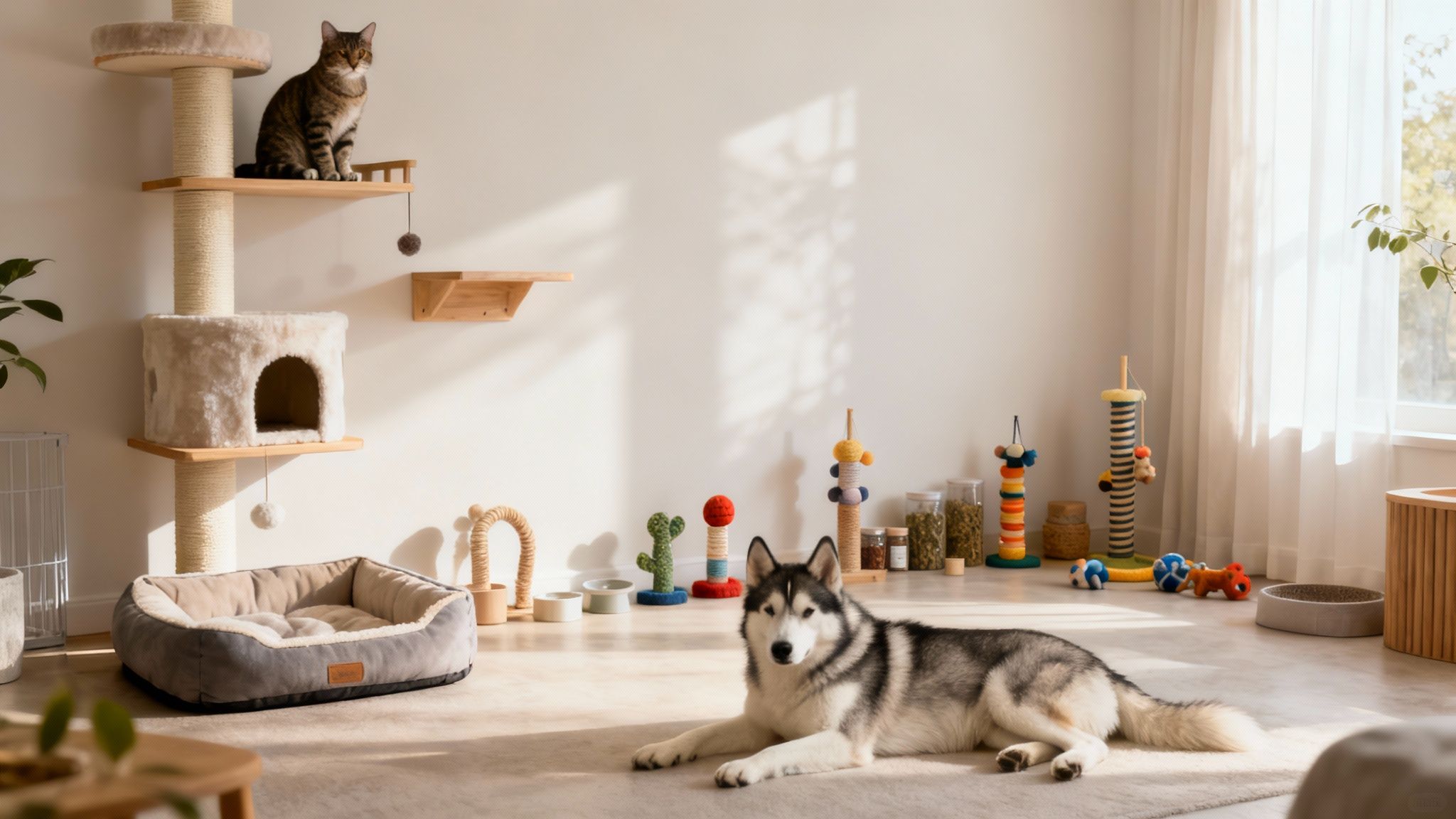
For your cat, the world revolves around safety and security. Their entire sense of well-being expands when they can move vertically. Giving them ways to get up high is one of the most powerful things you can do to put them in control of their own space and interactions.
Empowering Your Cat with Vertical Space
Cats are hardwired to seek high ground. It’s where they go to survey their kingdom and escape anything they see as a threat. When you provide these elevated sanctuaries, you give them the choice to engage or walk away, which is a massive stress-reducer.
Even a few simple additions can make a huge impact:
Tall cat trees or condos placed in the main living areas.
Sturdy, wall-mounted shelves or perches that create a "cat highway" around the room.
Clearing off the tops of bookshelves or cabinets so they have more safe landing spots.
These aren't just jungle gyms; they're vital escape routes and safe zones. To make sure your cat feels totally secure and to head off potential issues, it's a great idea to think through how to cat-proof your home. Taking these steps gives your cat confidence and helps prevent that panicked, scurrying run that can instantly trigger a Husky’s chase instinct.
Channeling Your Husky's Wild Energy
While your cat needs security, your Husky needs a job. Plain and simple. All that boundless energy and sharp intelligence has to go somewhere. An under-stimulated Husky will find their own fun, and that’s usually when things go sideways with the cat. You have to channel that powerful prey drive into something positive.
This is where nosework becomes your absolute best friend. It taps right into their instinct to hunt, track, and discover, scratching that primal itch in a safe, controlled way. Scent games are incredibly fulfilling for a dog, working their brain and body in a way that a simple walk around the block never could.
When your Husky is happily tired and mentally fulfilled from a good "hunt," their focus naturally shifts away from the cat. You can learn to build these enriching rituals and unlock your dog's natural superpowers.
👉 Download Your Free Dog Nosework Guide
Finally, creating separate safe spaces is non-negotiable. A dedicated room for your cat, blocked off with a baby gate, gives them a dog-free zone to totally relax. Likewise, a comfy crate can be a wonderful den for your Husky. You can find some great choices in our guide to the best dog crates that can serve as their own personal sanctuary.
By thoughtfully designing your home this way, you're doing more than just managing two pets. You're nurturing two distinct natures and creating a shared territory where both of them can feel safe, respected, and truly at ease.
Knowing When It's Not the Right Fit
Sometimes, no matter how much we hope or how patiently we work, a Husky and a cat just aren't meant to share a home. Getting to that realization isn't a failure. It’s actually the most responsible and compassionate choice you can make, honoring the deep duty we have to the animals in our care. Putting their safety and well-being first is always the right call.
This isn't just a gut feeling; it's backed up by people who know the breed inside and out. Data from the American Kennel Club shows that Siberian Huskies are one of the breeds least likely to be recommended for homes with cats. In fact, only 28% of breeders and trainers would even suggest the combination.
A 2020 survey also found that insurance claims for conflicts between dogs and cats were a staggering 2.3 times higher for Huskies than for the average breed. You can discover more insights about these findings here and what they mean for owners.
Clear Signs of Incompatibility
You have to be able to spot the red flags. While every animal is an individual, certain behaviors are clear signals that the risk is just too high and the stress is too much for a peaceful life together.
Look for these persistent warning signs from your Husky:
An intense, unblinking stare that they refuse to break.
Stiff, rigid body language, often paired with a low, quiet stalk.
A total inability to relax or settle down when the cat is in the room.
And from your cat:
Constant hiding or a flat-out refusal to come into shared spaces.
Hissing, spitting, or swatting every single time the dog gets close.
Changes in litter box habits or appetite, which are classic signs of chronic stress.
If you're seeing these behaviors over and over again, it's time to accept that permanent separation is the kindest path forward. This doesn't automatically mean rehoming. It can mean becoming a master of management—using doors, crates, and baby gates to create separate, parallel lives within the same house. It’s a huge commitment, but it’s one that ensures both your pets can finally relax and feel secure in their own space.
Read more about dog behavior and wellness on the Wild Pack blog:
Frequently Asked Questions
When you're thinking about bringing a Siberian Husky into a home with a cat, a ton of questions pop up. It makes sense—you're navigating some deep-seated instincts. Let's tackle a few of the most common ones that come our way.
Can an adult Husky learn to live with a cat?
Yes, it's possible, but it takes a whole different level of patience and management than starting with a puppy. You're working against established habits and a potentially unknown history. Success really comes down to the individual dog's personality and prey drive. Constant supervision is non-negotiable, and you have to be ready for the possibility that some adult Huskies might never be completely safe around a cat.
What are the best cat breeds for a Husky home?
Honestly, the cat's personality is way more important than its breed. You're looking for a confident, dog-savvy cat—one that won't immediately bolt and run. That running motion is the ultimate trigger for a Husky's chase instinct. Breeds known for being more laid-back and bold, like a Maine Coon or Ragdoll, sometimes have an easier time, but a brave mixed-breed from the shelter could be a perfect match.
How do I know if my Husky is playing or being aggressive?
This is a crucial distinction. Real play is usually a bit goofy and inefficient. Look for bouncy movements, play bows, and frequent pauses. Predatory behavior is the polar opposite. It’s quiet, stiff, and laser-focused. A fixed, unblinking stare, silent stalking, or a sudden lunge without any playful preamble are massive red flags that must be stopped immediately.
What if they used to get along but are now fighting?
A sudden shift in their relationship is a serious signal that something is wrong. The very first step should be a vet visit for both of them to rule out any hidden pain or illness, which is a common trigger for aggression. After that, look at what's changed in your home, as new stressors can throw everything off balance. You may need to separate them and start the slow re-introduction process all over again.